The man
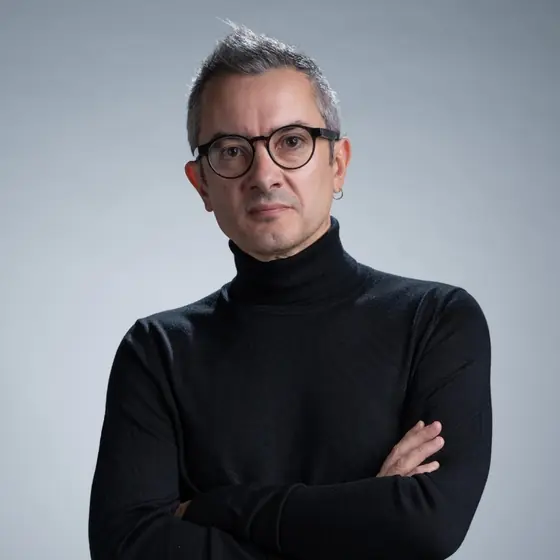
Arnaud Raffarin
Arnaud Raffarin is a countertenor. Trained at the Centre de musique baroque de Versailles, First Prize in singing at the Versailles conservatoire in 2003, he has sung for twenty years with Accentus, Le Concert Spirituel, Les Musiciens du Louvre and Les Talens Lyriques. He lives in Toulouse. Operabase (nouvel onglet)
Read the full career
He was born on 22 December 1976 in Châtellerault, where he learned classical guitar at the conservatoire. He studied musicology at the University of Tours (1996-1998), then singing at the Tours conservatoire in the class of Jean Nirouët (1999-2001). In 2001 he joined the Maîtrise of the Centre de musique baroque de Versailles, directed by Olivier Schneebeli, and in 2003 won the First Prize in singing with the jury’s congratulations at the Versailles conservatoire. He went on to study at the Abbey of Royaumont with Gérard Lesne (2003-2004) and in masterclasses with Alain Buet, Howard Crook, Noelle Barker and Jérôme Correas.
Noticed by Jean-Claude Malgoire, he sang Arbas in Campra’s Idoménée with La Grande Écurie et la Chambre du Roy, Nerillo in Cavalli’s L’Ormindo with Les Paladins and Jérôme Correas, an oratorio by Hasse alongside Gérard Lesne, and Handel’s Chandos Anthems with Les Passions and Joël Suhubiette.
From 2009 to 2018 he was a member of Accentus under Laurence Equilbey: soloist in Purcell, Poulenc, Howells and Barber, Pelléas et Mélisande under Sir John Eliot Gardiner, Fauré’s Requiem on tour in Latin America, Die Zauberflöte at the Opéra de Rouen, The Creation staged by La Fura dels Baus. With Le Concert Spirituel and Hervé Niquet he sang Purcell’s King Arthur, The Fairy Queen and The Indian Queen; with Marc Minkowski, Gluck’s Alceste; with Christophe Rousset, Les Indes galantes; with Ensemble Matheus, The Messiah. He recorded Giacobetti’s Lamentations with the ensemble Scandicus.
He teaches singing at the music schools of Auterive and then Tournefeuille, coaches actors and singers, and has created a method for singing with power without tiring the voice. Based in Toulouse, he runs Raf Voice Society, a training organisation certified Qualiopi in 2026, and co-founded a music label the same year.
Sources: Operabase, 2026 CV, training record of 21/09/2026, Vimeo 2014, consulted on 25/09/2026. Operabase (nouvel onglet) · Vimeo, Labyrinthe Musical en Rouergue (nouvel onglet) · Raf Voice Society, « Qui suis-je » (archive) (nouvel onglet)
The path
- 1996Musicology, University of Tours
- 1999Singing, Tours conservatoire, class of Jean Nirouët
- 2001Maîtrise of the Centre de musique baroque de Versailles
- 2003First Prize in singing, Versailles conservatoire
- 2003Abbey of Royaumont, with Gérard Lesne
- 2009Accentus, under Laurence Equilbey, until 2018
- 2026Toulouse: Raf Voice Society, and a co-founded label
Sources: 2026 CV, training record of 21/09/2026 · Operabase (nouvel onglet) · Centre de musique baroque de Versailles (nouvel onglet)
Booking, press
To programme AMOR SACRO, receive the photographs or speak to Arnaud: rvsrecords75@gmail.com
The character
I have sung for twenty years with a voice a man is not supposed to have.
I was told it came from Versailles. I was told it came from a child.
One night, after a concert, a woman handed me a notebook.
Six airs. Five black roses. One golden rose.
I already knew them.
Since then I ask one question, and I sing it:
does this voice belong to me?
The character is written. What he feels is true.
What we believe
There are voices one should perhaps never hear.
This one comes from a man, and it should not.
It rises where men do not rise.
For a long time these voices were made by taking something away from children.
Today, no one has taken anything from anyone. And yet the voice is there.
We believe a voice can outlive a body.
We believe beauty always asks for something in return.
We believe that what we call sacred sometimes begins in the flesh.
We believe that to love is to risk possessing, and that the only question worth asking is: can one love without possessing?
AMOR SACRO does not answer.
AMOR SACRO sings the question, six times, under two lights.
And leaves it to each of us to say which one is right.